
How will SMPTE’s move into IP help AV developers and integrators? Phil Ward finds out.
The goal of IPMX is to deliver the performance that the Pro AV world needs for any application of audio and video, including live production and presentation workflows, and to do it in the real world where training, equipment, and budgets are not always optimized for success.

Audio networks have played a major part in AV installations and productions since the days of analogue. Now, in the days of digital and IP, with multiple devices and locations involved, the stakes are much higher. Kevin Hilton looks at the current state of the technology and how interoperability is now a deciding factor.
When it comes to cables in consumer electronics, there is a high premium placed on making sure technology “just works.” We’re familiar with this concept from USB but consider your lowly power cable.

One reason broadcasters love AES67 is because it’s an open standard that enables low-latency, synchronized, uncompressed audio delivery over Ethernet/IP. A key challenge with AES67, however, is that it was written for local area networks (LANs), while broadcasters today increasingly need to deliver and receive audio over wide area networks (WANs).
Building on a remarkably successful 2021, despite the many challenges associated with the pandemic, AIMS moved into 2022 with a great deal of momentum.
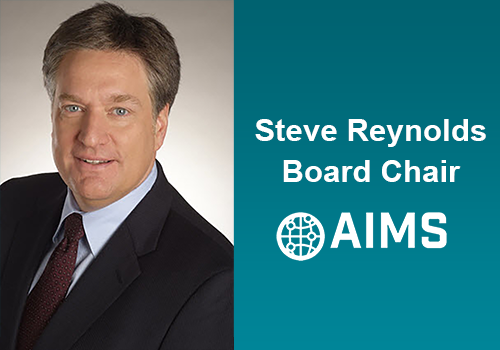
In a sign of member satisfaction with AIMS leadership, the full AIMS Board of Directors was re-elected for another term. Their good work continues, but without the leadership of Michael Cronk, who took on a new professional role that disqualifies him from serving. Steve Reynolds (Imagine Communications) has adroitly stepped into the role as board chair, working alongside AIMS Vice Chair Terry Holton (Yamaha), Chief Financial Officer Andreas Hilmer (Lawo), and board members Andrew Starks (Macnica) and Chuck Meyer (Grass Valley).
“I know I speak on behalf of the whole AIMS community when I say we will miss Mike enormously,” says Reynolds. “He has been instrumental in the formation and success of AIMS, and his commitment of time and energy over the past six years has made the AIMS mission of IP adoption a reality. Under his leadership, AIMS created programs such as the IP Showcase — and these programs continue today as a leading source of industry education and advancement. While I am certain that Mike will miss his work and colleagues within AIMS, I’m also confident that we’ll continue the good work in his stead.”
Following its launch late in 2021, the new AIMS Education Working Group is moving full steam ahead in working to expand the pool of industry professionals prepared to design, build, and operate standards-based IP media technology and solutions.
Although SMPTE ST 2110 is mature, stable, and working as a media-over-IP standard for broadcast, the industry needs more engineers who can do the design work, professionals who can do the implementation work, and operators who have the right skillset and expertise to work with these new IP-based systems. The new Education Working Group will work with other industry organizations to connect media professionals with better training, broad-based educational programs, and possibly even testing and certification they can use to validate their proficiency for prospective employers.
AIMS joined other organizations in another vital effort: the shift to more inclusive language in standards and engineering documents. The alliance formally announced its support for this shift and its embrace of efforts by standards bodies and other organizations to ensure that the language used to craft such documents is free from stereotypes, subtle discrimination, and demeaning or exclusionary expressions.
“We stand behind the work that SMPTE, the IEEE, and other leaders are doing to ensure that the standards and recommendations guiding our industry are built on inclusive language,” says AIMS Chief Financial Officer Andreas Hilmer. “Words have power, and it makes a difference when we employ more conscious, respectful use of language across not just standards documents, but communications of any kind. It’s a small but nevertheless significant step in the right direction.”
Adoption of AIMS’ proposed AV-over-IP standards and specifications, collectively known as IPMX (IP Media Experience), is also moving in a promising direction. IPMX was featured on the Macnica booth at InfoComm, and Phil Hippensteel penned this article in Sound & Video Contractor magazine about IPMX and his experience at the show.
As IP systems are now moving into a widespread market adoption phase – we’re deploying SMPTE ST 2110 and soon IPMX into more and more facilities where the engineering teams are spread thin and covering a lot of ground – the next step for the technology is accessibility and systemisation.
If you’re in AV, IPMX is an acronym you need to know. Short for Internet Protocol Media Experience, IPMX is a fast-emerging set of open standards and specifications for AV-over-IP. Although it shares many of the advantages offered by NewTek’s NDI (Network Device Interface), IPMX is different because it is an open standard.
The Alliance will work with industry partners to address a skills and expertise gap.
As Pro AV productions get more complex, the industry has longed for a set of common, ubiquitous, standards-based protocols for interoperability on a managed video-over-IP network. In 2017, as the first set of SMPTE ST 2110 standards were published, AV professionals saw the framework of their dream become reality.