
As part of our ongoing AVT Thought Leaders Series, we asked Sam Recine, Chair, Pro AV Working Group, AIMS to provide a rare insider’s perspective into the company’s philosophy and product roadmap heading into InfoComm 2022.
The Alliance for IP Media Solutions (AIMS) will host its first live interoperability demonstration of Internet Protocol Media Experience (IPMX) — a set of standards-based protocols designed to ensure interoperability for AV over IP — at InfoComm 2022, June 8-10 at the Las Vegas Convention Center. The first-of-a-kind demo will take place at AIMS Booth W1067 and will feature networking equipment and hardware and software nodes running both IPMX and SMPTE ST 2110, the standards suite on which IPMX is based. The demo will also highlight gateways between IPMX and other protocols, developer kits, and elements of IPMX-enabled AV-over-IP workflows.
“With this noteworthy IPMX interoperability demo at InfoComm 2022, we’re passing a critical milestone on the AIMS roadmap for open-standards-based media over IP,” said Sam Recine, chair of the Pro AV Working Group at AIMS. “We’re demonstrating the technical viability of IPMX in terms of multivendor interoperability, and that alone is exciting! But what’s also significant about this demo is the high level of industry support it signals, with leading manufacturers building IPMX support into their products — and more companies continually joining those ranks — as we move toward a more flexible, dynamic IP-based future for Pro AV.”
IPMX implements a standards-based approach based on SMPTE ST 2110, with features and capabilities that target the specific needs of the Pro AV industry. In addition to simplifying implementation of SMPTE ST 2110 and ensuring interoperability for AV-over-IP systems, IPMX incorporates other features tailored to Pro AV installations. These features include AMWA NMOS IS-04 and IS-05 for discovery, registration, and connection management, as well as specifications for copy protection and security.
Demo partners include Arista Networks, Cisco Systems, intoPix SA, Macnica, Matrox, Ross Video Limited, Stagetec and many others.
When it comes to cables in consumer electronics, there is a high premium placed on making sure technology “just works.” We’re familiar with this concept from USB but consider your lowly power cable.

One reason broadcasters love AES67 is because it’s an open standard that enables low-latency, synchronized, uncompressed audio delivery over Ethernet/IP. A key challenge with AES67, however, is that it was written for local area networks (LANs), while broadcasters today increasingly need to deliver and receive audio over wide area networks (WANs).
Building on a remarkably successful 2021, despite the many challenges associated with the pandemic, AIMS moved into 2022 with a great deal of momentum.
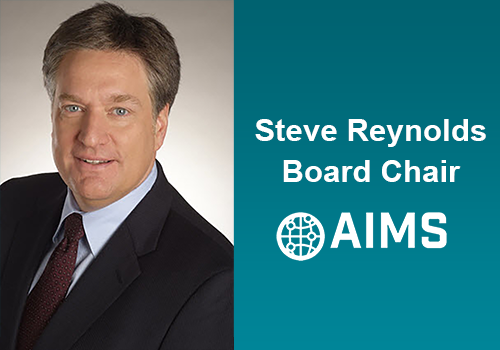
In a sign of member satisfaction with AIMS leadership, the full AIMS Board of Directors was re-elected for another term. Their good work continues, but without the leadership of Michael Cronk, who took on a new professional role that disqualifies him from serving. Steve Reynolds (Imagine Communications) has adroitly stepped into the role as board chair, working alongside AIMS Vice Chair Terry Holton (Yamaha), Chief Financial Officer Andreas Hilmer (Lawo), and board members Andrew Starks (Macnica) and Chuck Meyer (Grass Valley).
“I know I speak on behalf of the whole AIMS community when I say we will miss Mike enormously,” says Reynolds. “He has been instrumental in the formation and success of AIMS, and his commitment of time and energy over the past six years has made the AIMS mission of IP adoption a reality. Under his leadership, AIMS created programs such as the IP Showcase — and these programs continue today as a leading source of industry education and advancement. While I am certain that Mike will miss his work and colleagues within AIMS, I’m also confident that we’ll continue the good work in his stead.”
Following its launch late in 2021, the new AIMS Education Working Group is moving full steam ahead in working to expand the pool of industry professionals prepared to design, build, and operate standards-based IP media technology and solutions.
Although SMPTE ST 2110 is mature, stable, and working as a media-over-IP standard for broadcast, the industry needs more engineers who can do the design work, professionals who can do the implementation work, and operators who have the right skillset and expertise to work with these new IP-based systems. The new Education Working Group will work with other industry organizations to connect media professionals with better training, broad-based educational programs, and possibly even testing and certification they can use to validate their proficiency for prospective employers.
AIMS joined other organizations in another vital effort: the shift to more inclusive language in standards and engineering documents. The alliance formally announced its support for this shift and its embrace of efforts by standards bodies and other organizations to ensure that the language used to craft such documents is free from stereotypes, subtle discrimination, and demeaning or exclusionary expressions.
“We stand behind the work that SMPTE, the IEEE, and other leaders are doing to ensure that the standards and recommendations guiding our industry are built on inclusive language,” says AIMS Chief Financial Officer Andreas Hilmer. “Words have power, and it makes a difference when we employ more conscious, respectful use of language across not just standards documents, but communications of any kind. It’s a small but nevertheless significant step in the right direction.”
Adoption of AIMS’ proposed AV-over-IP standards and specifications, collectively known as IPMX (IP Media Experience), is also moving in a promising direction. IPMX was featured on the Macnica booth at InfoComm, and Phil Hippensteel penned this article in Sound & Video Contractor magazine about IPMX and his experience at the show.

The Alliance for IP Media Solutions (AIMS) today announced that Alun Fryer of Ross Video will serve as chair of the new AIMS Education Working Group (EWG) and AIMS board member Andrew Starks of Macnica will serve as the chair of the AIMS Marketing Working Group (MWG). Reena Mathews-Rutherford of Imagine Communications will continue in her role as MWG deputy chair.
“Alun has been one of the key contributors in the formation of the EWG, which is already building considerable momentum, and we’re pleased to welcome him as the group’s inaugural chair,” said AIMS Chairman of the Board Steve Reynolds. “AIMS board member Andrew Starks has also taken on new responsibilities in the MWG leadership position, offering an energetic agenda that will certainly help drive a lot of interest at the 2022 NAB Show and beyond. This should be an exciting year for AIMS, and I’m confident that Alun and Andrew will help the alliance continue its remarkable progress in fostering adoption of media over IP.”
Fryer is technical marketing lead for HyperConverged Solutions at Ross Video, where he provides leadership across product roadmaps, customer insights, industry, and technology trends. In addition to providing internal guidance at Ross, Fryer also contributes his time and expertise to broadcast media industry organizations and initiatives. As the new EWG chair, he will oversee work to define what is needed to improve training and expand educational opportunities. The AIMS group also will collaborate with other industry organizations to develop programs and certifications to rapidly expand the base of qualified engineers and operators to meet the growing demand for IP expertise.
“As the IP technology stack has come of age, education and training of industry professionals is crucial to drive successful deployment,” said Fryer. “I’m excited to be part of the AIMS initiative to remove barriers and enable professional development of IP media networking expertise.”
Starks serves as the director of product management for Macnica, where he leads the company’s standards efforts. In addition to being an AIMS board member, he has been a significant contributor to the IPMX initiative, including the development of the IPMX roadmap and its marketing plan. As chair of the Marketing Working Group, Starks will continue AIMS’ efforts to make the broadcast and Pro AV communities aware of the resources and events being made available by the alliance and its membership.
“I’m honored and excited to take on this new role,” said Starks. “My goal is to continue the great work of past MWG chairs and to explore new ways to bring standards-based IP technology to more industries.”
As IP systems are now moving into a widespread market adoption phase – we’re deploying SMPTE ST 2110 and soon IPMX into more and more facilities where the engineering teams are spread thin and covering a lot of ground – the next step for the technology is accessibility and systemisation.

If you’re in AV, IPMX is an acronym you need to know. Short for Internet Protocol Media Experience, IPMX is a fast-emerging set of open standards and specifications for AV-over-IP. Although it shares many of the advantages offered by NewTek’s NDI (Network Device Interface), IPMX is different because it is an open standard.
The Alliance will work with industry partners to address a skills and expertise gap.
As Pro AV productions get more complex, the industry has longed for a set of common, ubiquitous, standards-based protocols for interoperability on a managed video-over-IP network. In 2017, as the first set of SMPTE ST 2110 standards were published, AV professionals saw the framework of their dream become reality.